
Gates
5 gates, 18 arms. Every green arm has a red twin.
Proven red
Break what a gate guards, in memory, and watch it fail.
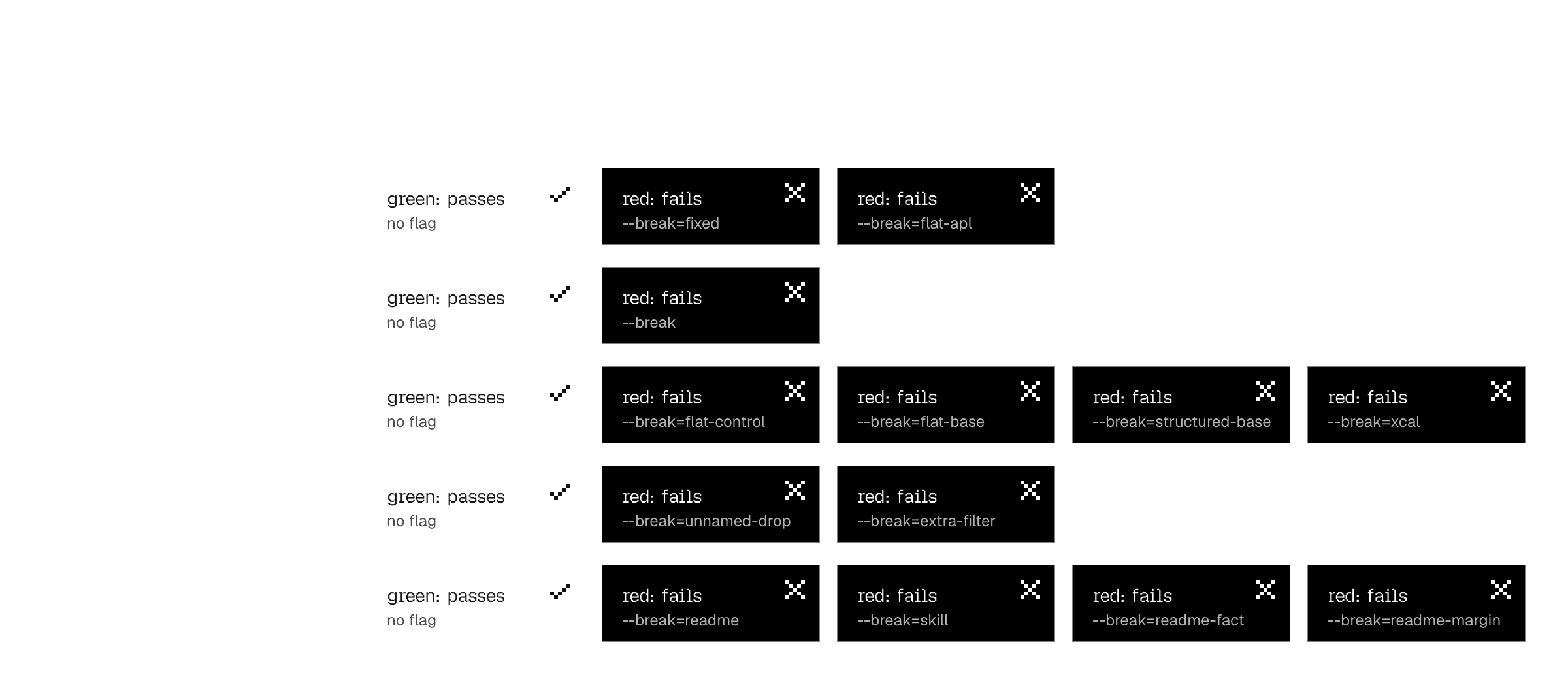
The five gates
What each guards, what it measured, and its arms.
-
Sparsity
gates/sparsity.mjsThe Kenyon cell rate holds because of the measured counts: CV 0.1110 real, 0.2177 flattened, 0.3577 fixed, bound 0.15.
gates/sparsity.mjsmust passgates/sparsity.mjs --break=fixedmust failgates/sparsity.mjs --break=flat-aplmust fail
-
Projection
gates/projection.mjsOne byte in, a little out: near beats far in 93.2% of pairs; sha256 scores -0.0847.
gates/projection.mjsmust passgates/projection.mjs --breakmust fail
-
No learning
gates/no-learning.mjsA small, bounded separation gain, median 12.8%, and a structure excess of 0.3584 shuffles cannot fake.
gates/no-learning.mjsmust passgates/no-learning.mjs --break=flat-controlmust failgates/no-learning.mjs --break=flat-basemust failgates/no-learning.mjs --break=structured-basemust failgates/no-learning.mjs --break=xcalmust fail
-
Budget
gates/budget.mjs1,210 of 22,586 raw rows dropped, 3.75% of synapses, by rules that name themselves.
gates/budget.mjsmust passgates/budget.mjs --break=unnamed-dropmust failgates/budget.mjs --break=extra-filtermust fail
-
Documents
gates/readme.mjsEvery figure in the README, SKILL.md and this site re-derives from the build.
gates/readme.mjsmust passgates/readme.mjs --break=readmemust failgates/readme.mjs --break=skillmust failgates/readme.mjs --break=readme-factmust failgates/readme.mjs --break=readme-marginmust fail
How much room the thresholds have
10 judged quantities ranked by slack; inside the 0.02 warn band is shouted.
| slack | quantity | measured | bound | |
|---|---|---|---|---|
| 0.0214 | (c1) p90 relative d' gain | 0.1786 | <= | 0.2000 |
| 0.0316 | (b3) p10 near-beats-far rate | 0.9316 | >= | 0.9000 |
| 0.0390 | (a1) CV of APL loop, worst seed | 0.1110 | <= | 0.1500 |
| 0.0916 | (c2) structure excess, ceiling | 0.3584 | <= | 0.4500 |
| 0.1084 | (c2) structure excess, floor | 0.3584 | >= | 0.2500 |
| 0.1997 | (b1) p10 near-pair median r | 0.9997 | >= | 0.8000 |
| 0.3032 | (c2) power-check excess, floor | 0.5532 | >= | 0.2500 |
| 0.4642 | (a3) x tighter than flat, worst seed | 1.8642 | >= | 1.4000 |
| 0.4791 | (b2) p10 near-far separation | 0.8791 | >= | 0.4000 |
| 1.5320 | (a2) x tighter than fixed, worst seed | 3.0320 | >= | 1.5000 |
A second connectome
On hemibrain:v1.2.1 the (c1) bound does not transfer; the structure statistic does, within 0.014.
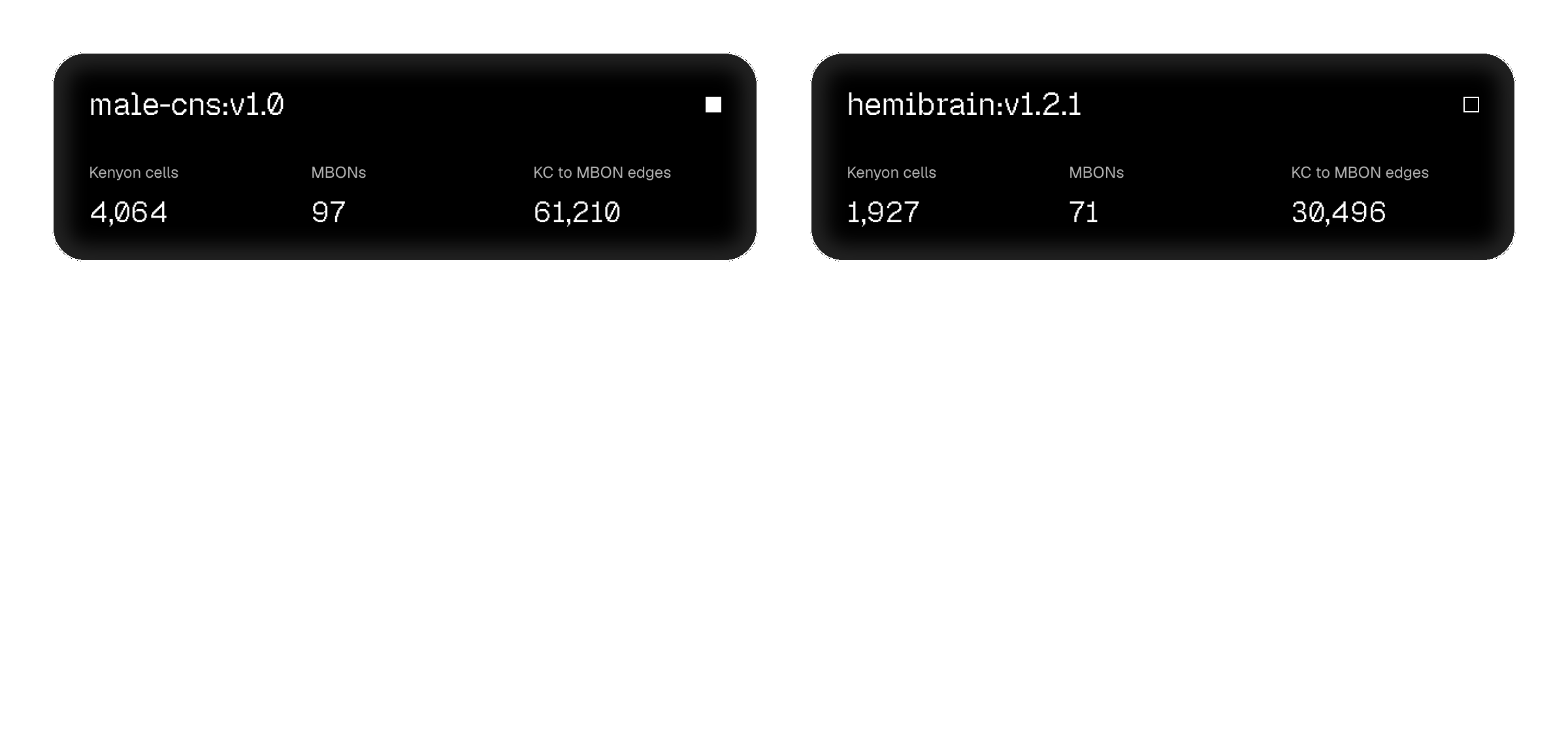
| male-cns:v1.0 | hemibrain:v1.2.1 | |
|---|---|---|
| Kenyon cells | 4,064 | 1,927 |
| MBONs | 97 | 71 |
| KC to MBON edges | 61,210 | 30,496 |
| (c1) shuffle control, p90 | 0.1786 | 0.2929 |
| (c1) flat control, p90 | 0.2429 | 0.3447 |
| gap the bound must fit in | 0.0643 | 0.0518 |
| (c2) structure excess | 0.3584 | 0.3440 |